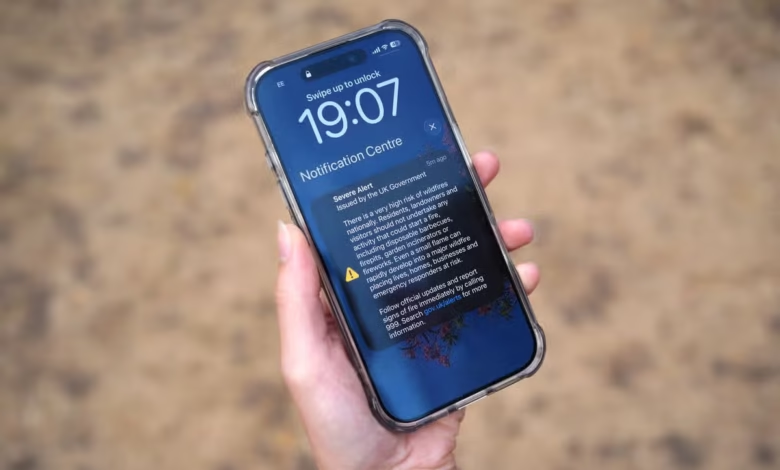
A government emergency alert can arrive on your phone without warning, often accompanied by a loud sound or vibration. For many people, the sudden message can be alarming, but these alerts are designed for one important purpose: delivering urgent information when there may not be enough time for traditional communication methods.


In the United States, emergency warnings can reach the public through several systems, including Wireless Emergency Alerts, the Emergency Alert System, NOAA Weather Radio, and other local notification channels. FEMA’s Integrated Public Alert and Warning System, commonly known as IPAWS, helps authorized public safety agencies distribute important warnings through multiple communication pathways.
What Is a Government Emergency Alert?
A government emergency alert is an official warning issued by an authorized public safety agency when people in a particular area may need to take immediate action or remain informed about a serious situation.
Depending on the circumstances, an alert may involve severe weather, an evacuation order, a dangerous person, a public safety threat, or another emergency requiring rapid communication. The exact wording and coverage area depend on the agency issuing the warning.
One of the most familiar forms is a Wireless Emergency Alert, or WEA. These messages are delivered to compatible mobile devices located within an affected geographic area. Unlike an ordinary text message, a WEA uses a distinctive sound and vibration intended to attract attention quickly.
The system is designed to reach people who may be in the danger area even if they are visitors or traveling through the region. This geographic targeting is an important part of modern emergency communication.
How Emergency Alerts Reach Your Phone
Behind a government emergency alert is a coordinated network involving authorized alerting authorities, FEMA systems, wireless providers, broadcasters, and other communication services.
FEMA’s IPAWS acts as a central platform that helps authorized federal, state, local, tribal, and territorial officials distribute emergency information. Its major pathways include Wireless Emergency Alerts and the Emergency Alert System, while other public warning technologies can also connect to the broader infrastructure.
When an authorized agency creates an alert, the message can be distributed through the appropriate systems. For wireless warnings, participating mobile carriers transmit the alert to compatible devices within the designated area.
This process is intended to reduce the delay between recognizing a serious threat and communicating useful information to the public.
Why Location Matters
Emergency alerts are generally designed around the geographic area affected by an incident. Officials can specify a county, state, or more precise area depending on the alerting system and circumstances.
FEMA explains that WEA distribution can use geographic targeting, including polygons or circles, to help define where a warning should be delivered. Because wireless coverage does not perfectly match geographic boundaries, some people outside the intended area can occasionally receive a warning.
That is why reading the entire message is more useful than assuming that everyone who receives it is necessarily facing the same level of danger.
Why Government Emergency Alerts Are Important
The biggest advantage of a government emergency alert is speed.
During a fast-moving emergency, people may not have time to search television websites, check social media, or wait for a news broadcast. A warning delivered directly to a nearby mobile device can immediately tell someone that something important is happening.
Ready.gov describes wireless emergency alerts as a way for officials to provide life-saving information quickly. The broader preparedness guidance also encourages people to have multiple ways of receiving emergency information because no single communication method should be treated as perfect.
An alert may provide instructions such as seeking shelter, avoiding a particular area, preparing for an approaching hazard, or following evacuation guidance. The most important information is usually contained in the message itself.
What Should You Do When an Alert Appears?
When an unexpected emergency warning appears, the first step is to stay calm and read it carefully.
Pay attention to the location mentioned, the type of emergency, the recommended action, and any information about when the situation is occurring. Do not dismiss a warning simply because the message is inconvenient or arrives at an unusual time.
If the alert instructs people to evacuate, shelter indoors, avoid an area, or take another immediate action, follow the direction of the responsible authorities whenever it is safe to do so.
It is also wise to look for additional information from trusted official sources if the message indicates that more instructions are coming. Emergency alerts are intended to start the communication process, not necessarily provide every detail about an incident.
Can You Turn Off Emergency Alerts?
Mobile phones contain settings that can control certain types of emergency notifications. However, the availability of individual settings depends on the device, operating system, carrier, and type of alert.
It is important to distinguish between emergency alerts and test alerts. FEMA guidance explains that disabling WEA test messages does not prevent a phone from receiving emergency alerts from federal, state, local, tribal, or territorial authorities.
Because settings vary, users should review their phone’s emergency notification options rather than assuming that turning off one category disables every government warning.
For safety reasons, disabling alerts should be considered carefully. A notification that seems unnecessary today could become important during a severe weather event or another rapidly developing emergency.
Government Emergency Alert vs. Regular Text Message
A government emergency alert is not simply an ordinary SMS sent by a government office.
Wireless Emergency Alerts use a dedicated emergency notification mechanism and are distributed through participating wireless providers. They are designed to reach compatible devices in a targeted area and use distinctive notification characteristics to attract attention.
Regular text messages, meanwhile, generally depend on a specific phone number or messaging service. They are not designed in the same way for geographically targeted mass emergency communication.
This distinction matters because people sometimes assume that every official-looking message is an emergency alert. The delivery method alone should not determine whether a message is trustworthy. Users should also consider what the message says and whether it provides clear, credible emergency instructions.
The Role of the Emergency Alert System
Wireless alerts are only one part of the broader public warning network.
The Emergency Alert System, or EAS, is a national warning system governed by Federal Communications Commission rules. It can be used by broadcasters and other participating communications providers to distribute emergency information, including national emergency messages and certain weather-related or local warnings.
This multi-channel approach is valuable because emergencies can affect communication infrastructure differently. Someone may lose internet access but still have television or radio reception, while another person may receive a mobile warning immediately.
The goal is to provide important information through more than one route whenever possible.
Are Emergency Alert Messages Always Accurate?
Emergency alert systems are operated by authorized public safety organizations, but that does not mean every message contains a complete picture of an evolving event.
Emergencies change quickly. Officials may issue an initial warning and then send updated information as conditions develop.
FEMA’s IPAWS materials emphasize the importance of effective, accessible alert messages and training for authorized alert originators. The system is designed to help officials communicate quickly, while the agencies issuing the messages remain responsible for the information and instructions they provide.
For that reason, people should read updates carefully rather than relying on an old warning after circumstances have changed.
How to Prepare Before an Emergency
The best time to think about emergency communication is before an emergency happens.
Keep your phone charged when severe weather or another known threat is approaching. Consider having an alternative charging method available during power outages, and maintain other ways of receiving information, such as a battery-powered radio when appropriate.
It is also helpful for households to discuss how they will communicate if normal services become disrupted. Ready.gov recommends preparing emergency plans and maintaining supplies that can help people cope during disasters.
A government emergency alert is most useful when people already understand what they are prepared to do if a warning arrives.
Frequently Asked Questions
What is a government emergency alert?
A government emergency alert is an official warning issued by an authorized public safety authority to communicate urgent information about a potential or ongoing emergency. In the United States, these warnings can be distributed through systems such as Wireless Emergency Alerts and the Emergency Alert System.
Why did I receive an emergency alert?
You may receive an alert because your compatible mobile device is located within or near an area targeted by an authorized warning. Geographic targeting is used to help deliver emergency information to people who may be affected.
Does receiving an alert mean I am in immediate danger?
Not necessarily. The alert may cover a broader area than the exact location of the incident. Read the message carefully to understand the hazard, location, timing, and recommended action.
Can emergency alerts be tested?
Yes. Public safety agencies can conduct tests to evaluate their alerting methods. Test messages should normally identify themselves as tests, exercises, or drills. FEMA notes that test-alert settings are separate from the ability to receive actual emergency alerts.
Do I need to sign up to receive Wireless Emergency Alerts?
For compatible devices and participating wireless services, FEMA states that there is no need to sign up or subscribe to receive IPAWS alerts.
Final Thoughts
A government emergency alert is one of the fastest ways public safety officials can communicate important information to people who may be affected by an emergency. Modern systems combine mobile technology with television, radio, weather communications, and other channels to make warnings more accessible and timely.
The most sensible response to an alert is not panic, but attention. Read the message, identify the affected location, follow official instructions, and look for updates when necessary. Understanding how these warnings work before an emergency occurs can make it much easier to respond appropriately when a real government emergency alert reaches your phone.