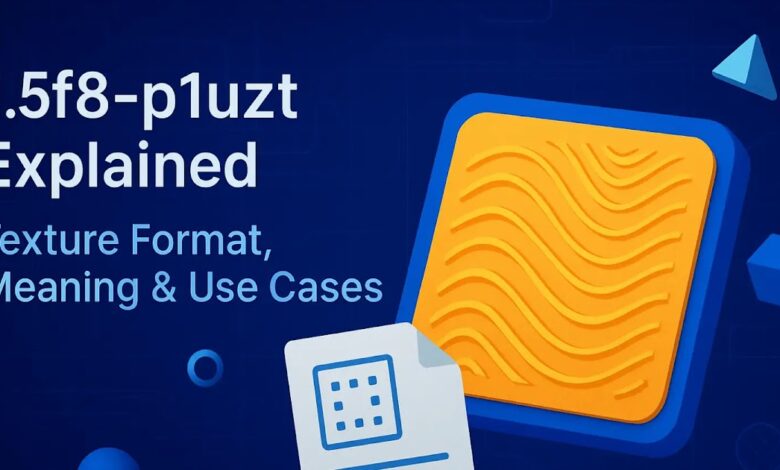
In the evolving world of digital design, unusual identifiers like “1.5f8-p1uzt texture” often appear in asset libraries, rendering engines, or experimental design systems. At first glance, it looks like a random string, but in practice, it represents a structured digital surface pattern used in 3D modeling, game environments, or procedural graphics workflows.

What makes this type of texture interesting is not just the name, but how it behaves inside rendering systems. Designers, developers, and 3D artists frequently rely on these assets to build realism, depth, and atmosphere in virtual environments.
What Exactly Is a 1.5f8-p1uzt Texture?
A texture like 1.5f8-p1uzt is typically treated as a procedural or system-generated surface map. Instead of being hand-painted, it is often created through algorithms or imported from material libraries where naming conventions are automatically assigned.
These textures can represent:
- Surface roughness patterns
- Material grain or noise layers
- Hybrid shader outputs
- Environment mapping data
In simpler terms, it is a digital skin applied to 3D objects to make them look more realistic or stylistically unique.
Why Designers Use Complex Texture Identifiers
You might wonder why such complicated names exist in the first place. The answer lies in workflow efficiency.
When working with thousands of assets, naming conventions like “wood_texture_01” quickly become limiting. Systems generate IDs like 1.5f8-p1uzt to ensure:
- No duplication in large libraries
- Easy tracking inside rendering engines
- Version control for procedural updates
- Faster automated asset referencing
This is especially useful in gaming pipelines and simulation environments where real-time rendering depends on precise asset indexing.
A Personal Observation from Design Workflows
While experimenting with procedural materials in a 3D environment last year, I came across a similar auto-generated texture ID. At first, I ignored it, assuming it was a broken file. Later, I discovered it was actually one of the most visually dynamic surface maps in the entire project.
That moment changed how I looked at system-generated assets—they are not random noise, but often hidden creative tools.
Real-World Applications and Industry Use Cases
Imagine a game development studio building an open-world survival game. The environment includes rocky mountains, weathered metal structures, and alien terrain.
Instead of manually designing each surface, the studio uses procedural textures like 1.5f8-p1uzt to:
- Automatically generate rock surface variation
- Add realism to metal corrosion layers
- Blend terrain transitions seamlessly
- Improve performance by reusing shader logic
This approach saves time while increasing visual complexity, making environments feel more immersive without overwhelming artists.
How It Behaves in Rendering Engines
In rendering pipelines such as Unreal Engine or Blender, a texture like this typically interacts with shader systems. It may influence:
- Diffuse mapping (base color appearance)
- Normal mapping (surface depth illusion)
- Specular response (light reflection behavior)
- Displacement effects (actual geometry distortion)
The combined effect is what gives objects their “real-world feel,” even though everything is mathematically generated.
Comparison: Procedural vs Handcrafted Textures
Below is a simple breakdown to understand how system-generated textures differ from manually created ones:
| Feature | Procedural Texture (e.g., 1.5f8-p1uzt) | Handcrafted Texture |
|---|---|---|
| Creation Method | Algorithm-based | Artist-designed |
| Consistency | Highly consistent | Depends on artist skill |
| Scalability | Excellent for large projects | Limited scalability |
| Uniqueness | Dynamic variations | Fixed design |
| Performance | Optimized for engines | May require manual optimization |
Both approaches are valuable, but procedural systems dominate large-scale environments due to efficiency.
Hidden Value Behind System-Generated Textures
One of the most overlooked strengths of textures like 1.5f8-p1uzt is adaptability. These assets can dynamically adjust based on lighting, distance, or environmental conditions.
For example:
- A surface may appear rough up close but smooth from afar
- Lighting conditions can shift material color tones
- Weather effects can alter surface reflectivity
This adaptability is what makes modern graphics feel alive rather than static.
Practical Applications Beyond Gaming
While gaming is the most obvious use case, these textures extend far beyond entertainment:
- Architectural visualization: simulating real building materials
- Film production: creating realistic CGI environments
- Virtual reality: enhancing immersion in simulated spaces
- Product design: testing surface materials before manufacturing
In all these industries, procedural textures reduce cost while improving realism.
Why It Matters for Designers Today
The rise of procedural systems means designers are no longer just “drawing surfaces.” Instead, they are directing systems that generate surfaces.
Understanding assets like 1.5f8-p1uzt helps creators:
- Work more efficiently with large libraries
- Improve realism in digital environments
- Experiment with non-traditional design workflows
- Save production time without sacrificing quality
This shift is quietly reshaping how digital art is created.
Future of Procedural Texture Systems
As AI and real-time rendering evolve, textures like this will likely become even more dynamic. We are moving toward systems where:
- Textures respond to user interaction
- Materials evolve over time in simulations
- AI generates surfaces based on prompts
- Real-world scanning merges with procedural generation
The line between real and digital surfaces will continue to blur.
Also Read: How to Install 35-DS3ChipDUS3: Step-by-Step Guide Update
Conclusion
The 1.5f8-p1uzt texture may appear like a random string, but it represents a powerful concept in modern digital creation—procedural surface generation. From gaming worlds to architectural simulations, these textures enable scalable, realistic, and highly adaptive environments.
What once required hours of manual design can now be achieved through intelligent systems that generate detail on demand. For creators, this is not just a technical shift—it is a creative expansion.
FAQs
1. Is 1.5f8-p1uzt texture a real file format?
It is not a standard file format but likely an internal identifier for a procedural or system-generated texture asset.
2. Where is this type of texture commonly used?
It is commonly used in game development, 3D rendering engines, simulations, and CGI production.
3. Can artists modify procedural textures?
Yes, most systems allow artists to adjust parameters like roughness, scale, and noise intensity.
4. Are procedural textures better than manual ones?
Neither is strictly better; procedural textures are ideal for scalability, while manual textures offer artistic control.
5. Why do these textures have random names?
They are often auto-generated by software systems to ensure uniqueness and avoid naming conflicts in large asset libraries.