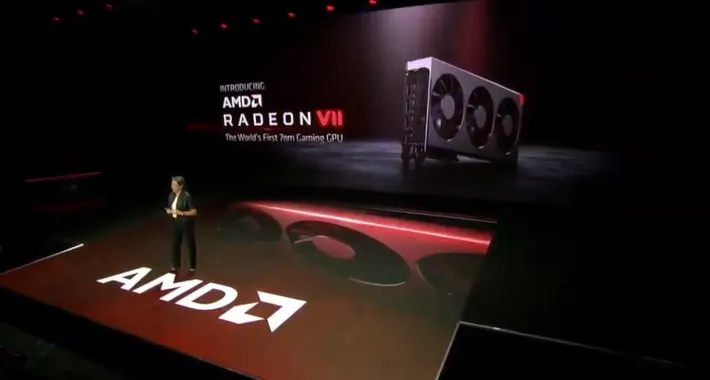
The AMD Radeon VII remains one of the most interesting graphics cards in AMD’s modern history. Introduced in 2019, it was the first consumer graphics card manufactured using a 7nm process and brought an unusually large 16GB of HBM2 memory to the desktop market. Although newer Radeon generations have since transformed the performance landscape, Radeon VII still attracts attention from hardware enthusiasts because of its specifications, architecture, and place in AMD’s GPU evolution.

What Was AMD Radeon VII?
The Radeon VII was a high-end desktop graphics card based on AMD’s Vega architecture. It was announced at CES 2019 and launched in February of the same year. Its name reflected the 7nm manufacturing process used for its GPU, rather than indicating that it belonged to a completely new architecture.
Under the hood, the card used the Vega 20 GPU, a refined version of the Vega design originally associated with AMD’s previous-generation graphics products. The move to 7nm allowed AMD to produce a more advanced chip while maintaining a relatively familiar architectural foundation.
At launch, the card was positioned as a premium gaming and content-creation product. Its combination of computational performance and substantial memory bandwidth made it particularly interesting for demanding workloads beyond conventional gaming.
A Major 7nm Milestone
One of the biggest reasons the AMD Radeon VII became historically important was its manufacturing technology. It was the first 7nm consumer GPU to reach the market, marking an important step in graphics hardware development.
The smaller process allowed AMD to pack a powerful GPU into a relatively compact silicon footprint while improving efficiency compared with earlier Vega products. The card featured approximately 13.2 billion transistors, demonstrating how quickly GPU designs were becoming increasingly complex.
The transition also showed AMD’s willingness to adopt newer semiconductor manufacturing technology ahead of much of the consumer graphics market. This helped establish a foundation for the company’s later GPU development.
16GB of HBM2 Memory
Memory was another defining feature of Radeon VII. The card included 16GB of HBM2 memory, which was considerably more than what many competing gaming graphics cards offered at the time.
HBM2, or High Bandwidth Memory 2, differs from conventional GDDR memory by using vertically stacked memory technology positioned close to the GPU. This approach enables a very wide memory interface and high bandwidth without relying on an extremely fast traditional memory bus.
Radeon VII delivered approximately 1 TB/s of memory bandwidth, an impressive figure for its generation. That bandwidth was useful for workloads involving large datasets, high-resolution textures, scientific calculations, and professional content creation.
For ordinary gaming, however, having 16GB did not automatically mean that the card would outperform every competitor. Game performance depends on numerous factors, including GPU architecture, clock speeds, drivers, rendering workloads, and software optimization.
Gaming Performance
At release, the AMD Radeon VII was designed to compete in the enthusiast graphics market. It was capable of delivering strong performance at 1440p and 4K resolutions, particularly in games where AMD’s architecture performed well.
The card was generally more interesting for users who wanted both gaming capability and substantial compute resources. In conventional gaming, its enormous memory capacity could be difficult to fully utilize because many titles simply did not require that much video memory.
Performance could also vary significantly between games. AMD’s driver improvements helped refine the card’s behavior over time, while game developers continued to optimize their engines for different GPU architectures.
This is an important distinction when looking at older graphics cards today. A specification sheet can explain what hardware contains, but real-world performance depends heavily on the software environment in which that hardware operates.
Vega Architecture Explained
The Vega architecture represented an important stage in AMD’s GPU development. It introduced several technologies intended to improve performance and flexibility, including High Bandwidth Cache Controller technology and features designed around modern compute workloads.
The Vega 20 chip used in Radeon VII was built with these concepts in mind. It contained 60 Compute Units and offered substantial raw computational capability.
AMD also designed Vega to perform strongly in professional and compute-heavy applications. That broader capability helped Radeon VII stand apart from graphics cards that were primarily focused on gaming.
For enthusiasts, this made the card especially intriguing as a multi-purpose workstation-style GPU that could also handle demanding games.
Radeon VII for Content Creators
Although it was marketed as a gaming graphics card, the AMD Radeon VII had characteristics that appealed to creators. Video editing, 3D rendering, scientific computing, machine-learning experiments, and other memory-intensive applications can benefit from large amounts of fast graphics memory.
The 16GB capacity was particularly useful when working with projects that could exceed the memory limits of mainstream graphics cards available at the time.
However, software support remained important. Not every professional application benefited equally from Radeon hardware, and some workloads were better optimized for competing GPU ecosystems.
Therefore, Radeon VII’s professional value depended heavily on the specific application and workflow. Its hardware capabilities were impressive, but practical performance always came down to software compatibility and optimization.
Power and Cooling
High performance came with significant power requirements. Radeon VII had a 300-watt typical board power, placing it firmly in the high-performance category.
The reference model used a triple-fan cooling design intended to manage the heat generated by the GPU. Under heavy workloads, users could expect noticeable fan noise, especially when the card was operating near its thermal and power limits.
This was not unusual for flagship-class graphics hardware of the period. Buyers considering a Radeon VII system needed an adequate power supply, good case airflow, and sufficient physical space for the card.
Why Radeon VII Was Short-Lived
Despite its impressive specifications, Radeon VII had a relatively short commercial life. AMD later shifted its consumer GPU strategy toward the RDNA architecture, which was designed with gaming performance and efficiency more directly in mind.
The arrival of RDNA-based Radeon graphics cards changed AMD’s direction significantly. Instead of continuing to develop Vega as the primary gaming architecture, AMD began building a new family around RDNA.
As a result, Radeon VII became something of a bridge between two generations of AMD graphics technology. It represented the final major consumer graphics card based on Vega before the company’s gaming-focused architecture moved forward.
AMD Radeon VII Today
The AMD Radeon VII is now a discontinued graphics card, meaning prospective buyers generally encounter it through the used hardware market rather than conventional new-product retail channels.
Its age is important when evaluating it today. Modern GPUs offer newer architectures, improved efficiency, more advanced media features, and better support for contemporary gaming technologies.
Still, Radeon VII can remain interesting for collectors, hardware enthusiasts, and users with specific compute or memory requirements. Its 16GB HBM2 configuration is unusual even by modern standards, making it a memorable piece of GPU history.
Used-market buyers should pay particular attention to the card’s condition. Graphics cards from this generation may have experienced years of intensive operation, and factors such as cooling performance, fan condition, previous workload, and overall system maintenance can affect reliability.
The Legacy of Radeon VII
The importance of Radeon VII goes beyond its gaming benchmark results. It demonstrated that AMD was willing to take significant technological steps in semiconductor manufacturing and memory design.
Its 7nm GPU represented an important manufacturing milestone, while its 16GB HBM2 configuration showed AMD’s willingness to prioritize enormous memory bandwidth and capacity.
The card also helped bridge AMD’s transition from Vega toward RDNA. That makes it particularly interesting when viewed within the company’s broader graphics history.
For technology enthusiasts, products do not always need to become runaway commercial successes to become historically significant. Radeon VII is a good example of a product whose specifications and technological decisions helped illustrate where GPU development was heading.
Is AMD Radeon VII Still Worth Considering?
Whether the AMD Radeon VII makes sense today depends on the intended workload and the price of a used unit. For someone primarily interested in modern gaming, newer graphics cards generally provide a more contemporary feature set and better efficiency.
For collectors or users who specifically need 16GB of graphics memory and strong memory bandwidth, however, Radeon VII can still be an interesting piece of hardware.
The key is to avoid judging the card solely by its original flagship status. Technology changes quickly, and a high-end graphics card from 2019 should be evaluated according to today’s applications, drivers, power consumption, and available alternatives.
Frequently Asked Questions
When was AMD Radeon VII released?
AMD released Radeon VII in February 2019. It was introduced as a high-end desktop graphics card based on the 7nm Vega 20 GPU.
How much VRAM does Radeon VII have?
The card comes with 16GB of HBM2 memory. Its memory system provides roughly 1 TB/s of bandwidth, which was exceptionally high when the GPU launched.
Is Radeon VII good for 4K gaming?
Radeon VII was capable of 4K gaming and could deliver strong results in suitable titles. However, modern games and newer GPU architectures can offer a different balance of performance, efficiency, and features.
Is Radeon VII discontinued?
Yes. Radeon VII is a discontinued product and is no longer part of AMD’s current consumer graphics-card lineup.
Why is Radeon VII historically important?
Its significance comes from several factors, including its 7nm manufacturing process, 16GB HBM2 memory, very high memory bandwidth, and its position as one of the final major consumer products built around AMD’s Vega architecture.
Final Thoughts
The AMD Radeon VII occupies a distinctive place in graphics-card history. It combined a pioneering 7nm manufacturing process with 16GB of HBM2 memory and exceptionally high memory bandwidth, creating a product that was unusual even among high-end GPUs.
While newer graphics cards have surpassed it in many areas, Radeon VII remains valuable as a snapshot of AMD’s technological direction at the end of the Vega era. Its ambitious memory design, high computational capability, and role in the transition toward RDNA make it a fascinating GPU for anyone interested in the evolution of modern graphics hardware.