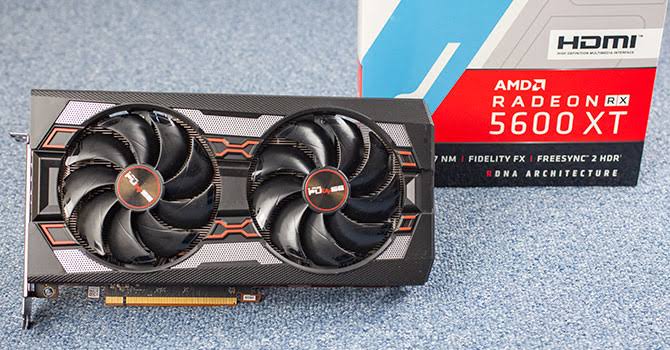
The AMD Radeon RX 5600 XT arrived at a time when PC gamers wanted strong 1080p performance without spending premium money on a graphics card. Although newer generations have transformed the GPU market, this Navi-based card remains an interesting piece of AMD’s graphics history. Its combination of gaming performance, 6GB of GDDR6 memory, and relatively efficient power consumption made it a popular choice for mainstream gaming PCs.

Today, the RX 5600 XT is primarily interesting on the used market and for people building affordable gaming systems. Its age means it cannot compete with the latest graphics cards in every area, but its underlying performance can still be useful for 1080p gaming. Understanding where the card came from, what it can handle, and where its limitations appear helps explain why it continues to attract attention.
What Is the RX 5600 XT?
The AMD Radeon RX 5600 XT is a desktop graphics card based on AMD’s first-generation RDNA architecture, commonly known as Navi. It was introduced in early 2020 as a performance-focused 1080p gaming option.
AMD positioned the card below the Radeon RX 5700 series while targeting gamers who wanted higher performance than entry-level GPUs could provide. The result was a card that focused heavily on traditional rasterized gaming rather than advanced features such as hardware-accelerated ray tracing.
The RX 5600 XT uses a 7nm manufacturing process and features 36 Compute Units. Depending on the specific model and BIOS configuration, clock speeds can vary considerably between different versions from board partners.
Its standard memory configuration includes 6GB of GDDR6 VRAM connected through a 192-bit memory interface. That combination gave the card enough bandwidth for demanding 1080p games while keeping the overall design relatively compact compared with more powerful GPUs.
Key Hardware Specifications
The specifications tell an important part of the RX 5600 XT story. The GPU contains 2,304 stream processors and is built around AMD’s RDNA architecture. It was designed primarily for conventional gaming workloads, where its strong shader performance could deliver smooth frame rates at 1080p.
The 6GB GDDR6 memory was also a significant step forward compared with older mid-range graphics cards that relied on slower memory technologies. GDDR6 provided substantially higher bandwidth and helped the GPU maintain performance in demanding games.
One important detail is that RX 5600 XT specifications are not completely identical across every manufacturer. Some models received BIOS updates that increased their memory speed and power limits. As a result, two cards carrying the same RX 5600 XT name can deliver slightly different performance.
1080p Gaming Performance
The biggest strength of the AMD Radeon RX 5600 XT has always been 1080p gaming. When it launched, the card was capable of running many modern games at high settings while maintaining strong frame rates.
Performance naturally depends on the game, processor, graphics settings, and driver version. Competitive games that are less demanding can run at very high frame rates, while visually intensive single-player titles may require reduced settings to maintain smooth gameplay.
For players using a 1080p monitor, the card can still make sense when expectations are realistic. Older and well-optimized games are generally comfortable territory, while newer AAA releases can place greater pressure on the GPU’s 6GB memory capacity.
This distinction is important because modern games increasingly use more VRAM. A graphics card that once felt comfortably equipped for high-quality 1080p gaming can now encounter limitations in games with large textures and demanding graphical effects.
How It Handles 1440p
Although the RX 5600 XT was primarily designed for 1080p, it can also run games at 1440p with appropriate settings. However, this resolution puts substantially more pressure on the GPU and its 6GB memory.
Gamers interested in 1440p may need to lower texture quality, shadows, effects, or other demanding settings. Upscaling technologies can also help in supported games by reducing the internal rendering workload.
For casual 1440p gaming, the card can still be usable. However, anyone purchasing a graphics card specifically for long-term 1440p performance should understand that the RX 5600 XT is an older design with limited VRAM compared with many newer alternatives.
Power Consumption and Cooling
Power efficiency was one of the improvements brought by AMD’s 7nm RDNA generation. The RX 5600 XT generally has a board power rating around 150 watts, although actual specifications vary between models.
Most aftermarket versions use substantial heatsinks and one or two cooling fans. Better-designed models can operate relatively quietly during ordinary gaming, while compact versions may run warmer and louder under sustained workloads.
A suitable power supply is important, especially because different factory-overclocked versions can have different power requirements. Buyers considering a used RX 5600 XT should also inspect the condition of the fans, heatsink, and power connectors.
Drivers and Software Support
Graphics drivers can have a major impact on the experience of an older GPU. AMD has continued supporting the RDNA generation through its Radeon software ecosystem, although newer architectures naturally receive greater attention as technology advances.
Driver updates can improve compatibility, fix game-specific problems, and introduce broader software improvements. At the same time, owners of an older card should not expect every modern graphics feature to work in exactly the same way as it does on current-generation hardware.
For a second-hand gaming PC, checking the operating system, driver compatibility, and motherboard configuration before buying can prevent unnecessary troubleshooting later.
Ray Tracing and Modern Features
One of the clearest limitations of the RX 5600 XT is its lack of dedicated hardware ray-tracing accelerators. The card belongs to an architectural generation that predates AMD’s hardware ray-tracing implementation.
That does not prevent users from playing games that contain ray-traced effects, but the performance cost can be substantial because the hardware was not designed specifically for those workloads.
The card also lacks some of the advanced AI and rendering capabilities available on newer GPUs. Gamers focused on modern graphical technologies should therefore look beyond the RX 5600 XT.
For traditional rasterized gaming, however, the situation is different. The GPU can still provide a capable experience when paired with sensible graphics settings.
The Importance of the 6GB VRAM
The 6GB memory capacity deserves particular attention. When the RX 5600 XT launched, 6GB was generally considered appropriate for its target market. Today, however, VRAM requirements have increased across many demanding PC games.
Running a game at 1080p does not automatically mean that 6GB will always be enough. Texture quality, game engine design, resolution, visual effects, and future software requirements can all affect memory usage.
Players using an older RX 5600 XT can often extend its useful life by adjusting texture settings rather than immediately lowering every graphical option. In some games, reducing a few memory-heavy settings can provide a better balance between visual quality and performance.
Used-Market Considerations
Because the RX 5600 XT is several generations old, many examples available today are second-hand. Condition therefore matters almost as much as the original specifications.
A used card may have spent years running games or other demanding workloads. That does not automatically make it unreliable, but prospective buyers should pay attention to fan noise, temperatures, visible dust buildup, corrosion, damaged connectors, and signs of physical repair.
The exact model is also worth researching. Different manufacturers produced RX 5600 XT cards with different coolers, clock speeds, power limits, and BIOS configurations.
A clean, properly maintained card with a capable cooling system can be a very different ownership experience from a heavily worn model.
Who Should Consider It?
The AMD Radeon RX 5600 XT remains most relevant to budget-conscious PC builders who primarily play games at 1080p. It can also be useful for upgrading an older desktop when a compatible used card is available at an appropriate price.
Its strongest case is traditional gaming rather than cutting-edge graphics technology. Players who mainly enjoy esports titles, older AAA games, independent games, and well-optimized releases may find its performance perfectly adequate.
On the other hand, users building a new high-end gaming computer, targeting demanding 1440p gaming, or wanting extensive ray-tracing capabilities should consider newer hardware.
RX 5600 XT vs. Newer Graphics Cards
Comparing the RX 5600 XT directly with modern GPUs requires some context. Newer cards benefit from architectural improvements, larger memory capacities, improved efficiency, and newer rendering technologies.
That does not make the RX 5600 XT useless. Hardware does not suddenly stop working when a new generation arrives. Its practical value depends heavily on the games being played and the price of the hardware.
A reasonably priced used RX 5600 XT can still be attractive for a specific budget. Paying too much for an aging card, however, reduces its appeal because newer entry-level and mid-range GPUs provide longer-term support and more modern capabilities.
Frequently Asked Questions
Is the RX 5600 XT still good for gaming?
Yes, it can still be useful for 1080p gaming. Its performance is strongest in traditional rasterized games, although newer demanding titles may require reduced settings because of its age and 6GB VRAM capacity.
Can the RX 5600 XT run modern games?
It can run many modern games, but results vary significantly. Less demanding titles may perform well, while graphically intensive releases can require compromises in resolution and graphics quality.
Does the RX 5600 XT support ray tracing?
The card does not include dedicated hardware ray-tracing accelerators. As a result, it is not designed to deliver the ray-tracing performance associated with newer GPU generations.
Is 6GB VRAM enough for 1080p?
Six gigabytes can still work for 1080p gaming, particularly when texture settings are managed carefully. However, some newer games can exceed that capacity under demanding settings.
Is the RX 5600 XT worth buying used?
Its value depends heavily on the condition of the card, its exact model, and the asking price. A well-maintained example can remain useful for a budget 1080p gaming system.
Final Thoughts
The AMD Radeon RX 5600 XT represents an important generation of mainstream PC graphics hardware. Its 7nm RDNA architecture, 6GB GDDR6 memory, and strong 1080p performance gave it a compelling position when it launched.
Years later, its strengths and weaknesses are easier to see. It remains capable of traditional 1080p gaming, but limited VRAM, the absence of dedicated ray-tracing hardware, and its older architecture make it less suitable for demanding modern workloads.
For the right budget-focused PC, the card can still have a practical role. Its real value comes from matching its capabilities with realistic expectations rather than expecting an older mid-range GPU to perform like current-generation hardware. For gamers who understand those limitations, the RX 5600 XT remains a noteworthy chapter in AMD’s graphics-card lineup.